I like it,, Air. That has to be in the top 5 if not # 1.
Originally Posted by airair
Ben Hogan's pane of glass?
(Can't find the picture from his book)
There are so many great images in that book, too! The grip, the turning belt ahead of the arms....
But before Hogan, was Jones so...
__________________
HP, grant me the serenity to accept what I cannot change, the courage to change what I can, and the wisdom to know the difference. Progress and not perfection is the goal every day!
Hogan's 'plane of glass' Plane illustration is arguably the most famous illustration in golf. It is also among the most erroneous. Especially when combined with the three accompanying illustrations showing the 'baseline' shift to the right during the Downstroke.
My benchmark of "important" demands that the illustration also be correct.
I think the one you put up there is hard to beat Yoda,
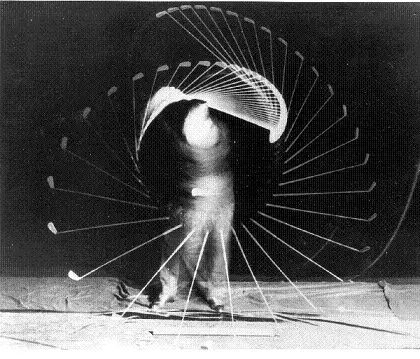
But if you develop it into something like this, it will be even better, IMO:
A Bobby Jones like strobe with visble hands and without the flip through impact will tell still tel a lot about the ideal impact position but also a lot about H2 get there.
Hogan's 'plane of glass' Plane illustration is arguably the most famous illustration in golf. It is also among the most erroneous. Especially when combined with the three accompanying illustrations showing the 'baseline' shift to the right during the Downstroke.
My benchmark of "important" demands that the illustration also be correct.
Next?
If the benchmark is that the illustration also be correct wouldn't that disqualify your pic. also as it doesn't include a real event of impact as no clubshaft will be in that position in a real swing at impact. They actually deflect the exact opposite way at that moment as the clubhead goes to a lead position from a lag position.
sasho mackenzie says:
"The final phase of shaft deflection was the most
important since it explained clubhead orientation at impact.
Over the final few hundredths of a second of the downswing,
the clubhead rapidly moved from its maximum
lagging position into its maximum leading position at
impact. The lead deflections at impact for the normal
optimized simulation were approximately 6.25 cm in
magnitude. The complete removal of radial force during
the downswing only reduced lead deflection to 4.72 cm
(Fig. 8; Table 1). Therefore, when acting in isolation, the
tangential forces that occur during the late phase (after
0.15 s) of the downswing were a major contributor to the
lead deflection at impact. The complete isolation of radial
force demonstrated that, while acting alone, radial force
only resulted in 1.22 cm of lead deflection at impact
(Fig. 9; Table 1)."
the full paper can be found at his website.
UofS Theses: Understanding the role of shaft stiffness in the golf swing
If the benchmark is that the illustration also be correct wouldn't that disqualify your pic. also as it doesn't include a real event of impact as no clubshaft will be in that position in a real swing at impact. They actually deflect the exact opposite way at that moment as the clubhead goes to a lead position from a lag position.
Point taken, wedgy, but I stand by the point of the photo: the golfer should keep the ball and the head behind the hands.
Also, the stressed shafts could be taken to represent Clubhead Lag Pressure Point Pressure as felt in the #3 Pressure Point (right index finger). That is the way it feels.
Point taken, wedgy, but I stand by the point of the photo: the golfer should keep the ball and the head behind the hands.
Also, the stressed shafts could be taken to represent Clubhead Lag Pressure Point Pressure as felt in the #3 Pressure Point (right index finger). That is the way it feels.
Finally, my personal alignments are correct.
Yes i can understand that it is a good visual and feel to shoot for regardless if it( the shaft lag position at impact) happens or not. Never questioned your personal alignments as i'm more than sure they are correct for you.




 Hybrid Mode

